Technology
What actually happens when green laser light meets a fat cell
Emerald is built on photobiomodulation — using light to produce a photochemical effect in tissue without generating clinically relevant heat. Here is the mechanism, in full.
Mechanism
Photobiomodulation, not thermal injury
Thermal devices work by causing controlled tissue damage and carry the associated risk profile. Non-thermal laser modulates cell behaviour instead — which is why there is no anaesthetic, no wound and no recovery period.
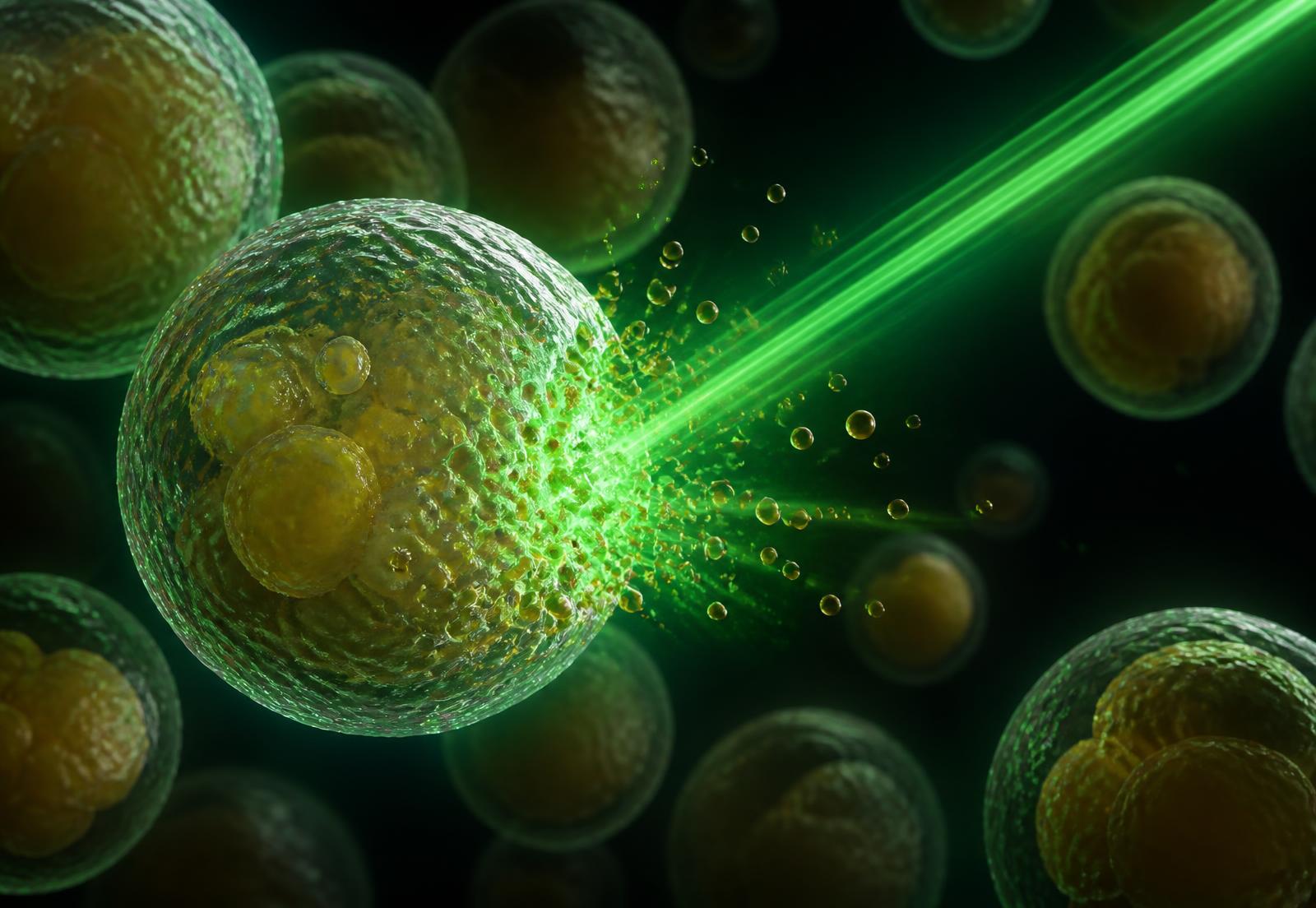
In adipose tissue the documented mechanism is a transitory pore in the adipocyte membrane. Histological work has shown the cell remains viable throughout; what changes is that its stored lipid content is released rather than the cell being destroyed.
This distinction matters clinically. Because no cells are killed, there is no inflammatory clearance cascade, no cold-induced panniculitis risk and no post-treatment restriction on activity.
Step by step
The four stages of a treatment
1. Light is delivered
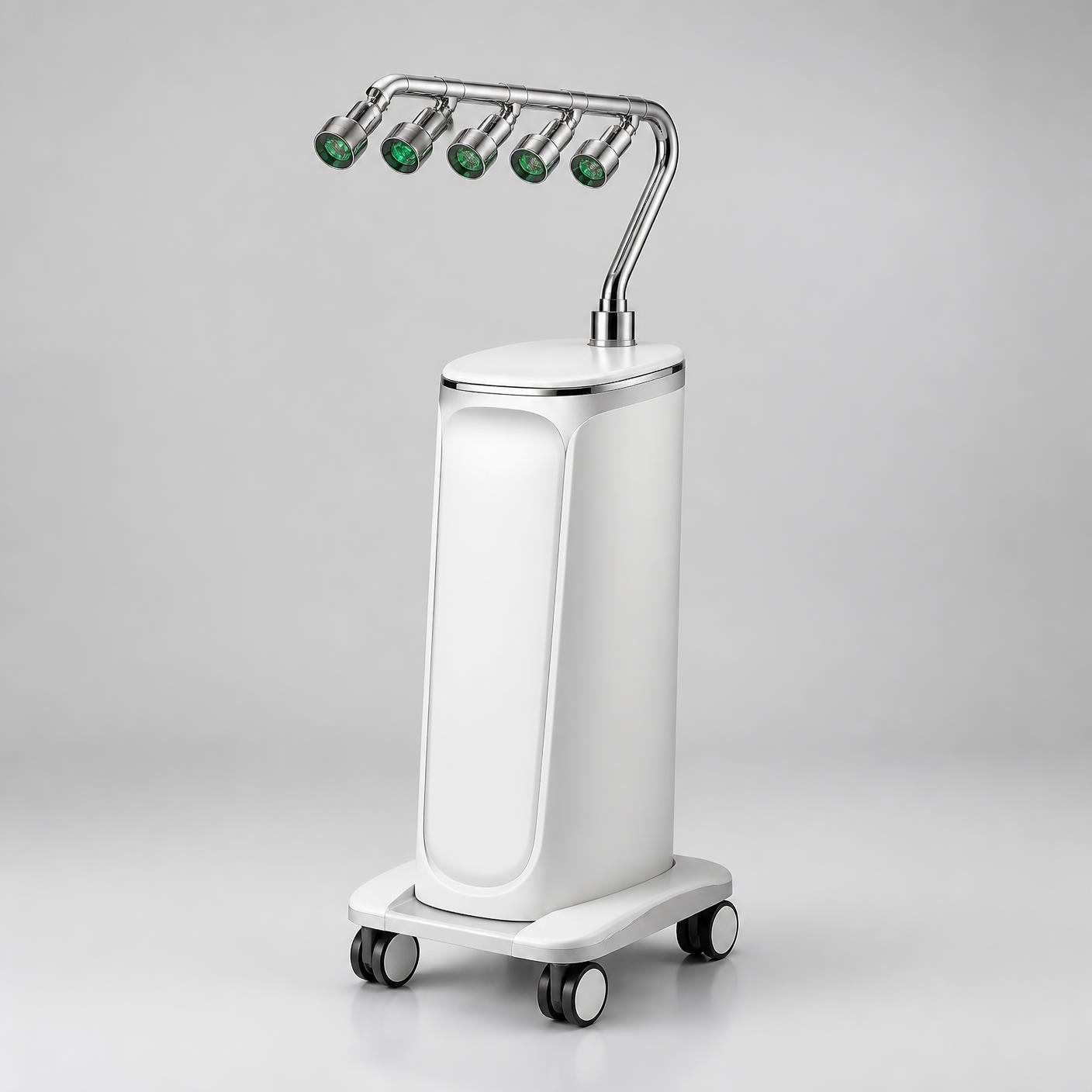
Ten independent 520–542 nm diodes are positioned above the treatment area. No contact, no pressure, no heat — the patient lies still for 30 minutes.
2. A transitory pore forms
Green light interacts with the adipocyte membrane, forming a temporary pore. This is a photochemical event, not a thermal one.
3. Lipid moves out of the cell
Stored triglyceride passes from inside the fat cell into the interstitial space. The cell itself remains viable and intact.
4. Normal clearance takes over
Released lipid is transported by the lymphatic system and processed through normal metabolic pathways over the following days.
Wavelength
Why 520–542 nm green rather than red?
Absorption in biological tissue is wavelength-dependent. Adipose tissue does not respond identically to green (520–542 nm) and red (635 nm) light, so outcome data from one wavelength does not transfer to the other.
Absorption profile
Green light interacts with adipose tissue differently at the same delivered energy, producing a stronger measured response in comparative work.
Diode architecture
Ten independently articulated heads allow coverage of the waist, hips and thighs in a single positioned session.
Non-thermal by design
Output is intentionally low-level. The effect is photochemical, so tissue temperature is not the working variable.
Safety
What the safety profile looks like
Non-thermal delivery means the adverse-event profile differs fundamentally from thermal or cryogenic devices.
No thermal injury
No heating of skin or subcutaneous tissue during treatment.
Cells remain viable
Adipocytes are emptied rather than destroyed, avoiding necrotic clearance.
No downtime
Patients return to normal activity immediately after a session.
Monitored follow-up
Prospective follow-up found no clinically significant lipid or liver panel change at 12 months.
Glossary
Key terms, defined
- Photobiomodulation
- The use of light to produce a photochemical effect in tissue without clinically relevant heating. The mechanism behind low-level laser therapy.
- Low-level laser therapy (LLLT)
- Laser therapy delivered at intensities too low to heat tissue, producing biological effects photochemically.
- Adipocyte
- A fat cell. In laser body contouring, the target cell whose stored lipid is released rather than destroyed.
- Transitory pore
- A temporary opening in the adipocyte membrane formed after laser exposure, allowing intracellular lipid to move into the interstitial space.
- Circumference reduction
- A measured decrease in the girth of a treated area such as the waist, hips or thighs. Distinct from weight loss.
- 510(k) clearance
- A US FDA market clearance pathway demonstrating a device is substantially equivalent to a legally marketed predicate, supported by clinical data.
Experience the Erchonia range in your clinic
Book a private demonstration with the Erchonia Lasers Australia team, or find your nearest treating clinic.